
CONCEPT DOSSIER / NOT A RELEASED GAME
Last Possession
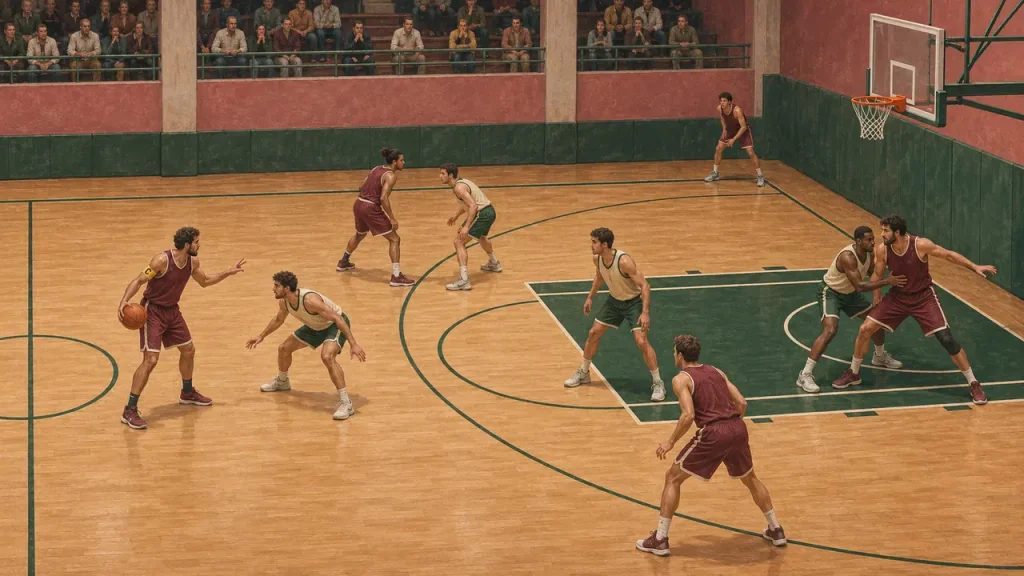
Last Possession is a concept about organising a team decision when the remaining window is short. The captain begins with a primary action, watches the defense disrupt or permit it and chooses whether the fallback is still available. The intended tension comes from shared preparation and commitment, not from assuming that a last-second solo shot is always the most meaningful ending.
Preparation happens before the urgent moment
The captain needs to understand the team’s primary idea before the possession begins. A brief preparation view can establish the intended spacing and a fallback relationship. It should explain the purpose of each movement rather than demand a sequence of memorised button presses. Once play resumes, the same relationships need to remain visible through body orientation and timing. The player should not be asked to reconstruct an unfamiliar plan while the clock is already the dominant source of pressure.
The defense changes the value of waiting
A closed lane may justify another movement when there is enough time to create it. Later, the same delay may remove a reasonable chance. The captain must read both the defensive response and the available window. The fallback note considers how to communicate that trade without prescribing a single correct shot. The goal is a choice whose urgency can be understood, not an arbitrary countdown that makes every decision feel equally rushed.
A fallback must belong to the team
A secondary option is useful only if teammates can recognise the conditions that make it relevant. It cannot depend on the captain silently changing the plan while everyone else continues an unrelated animation. The proposed design uses a small number of clear signals and movement relationships. A teammate’s adjustment should indicate that the shared idea has changed. The captain-view study examines how that communication can remain readable without a complete overhead solution.
Commitment should have a visible reason
At some point the captain must act on the chance that exists rather than continue searching for a perfect one. The decision should follow from spacing, defensive pressure and time, not a sudden interface instruction. A less dramatic attempt can be sensible if it uses a clear opening. A failed outcome does not automatically prove that the earlier choice was poor. The proposed review should distinguish decision quality from the final result instead of awarding all meaning to whether the ball reaches the target.
The arena supports the team story
The visual setting uses a compact indoor court with readable lines, restrained spectators and strong separation between the two teams. The camera should preserve the relevant off-ball relationship as the captain moves. Crowd reaction can provide atmosphere without masking communication cues. The project does not claim real athletes, leagues or tournament histories. Its fictional team context exists to support the tactical problem rather than imitate an unauthorised official competition.
A short scenario before a complete season
Last Possession remains a concept study, with no public version or release schedule announced. An initial prototype would use one prepared action, one fallback and a limited set of defensive reactions. It would ask whether players can explain when the fallback became useful and why they finally committed. We have not published testing results. A larger match or season mode would make sense only after this short scenario communicates its shared decisions clearly.