
Read the defense before the prompt
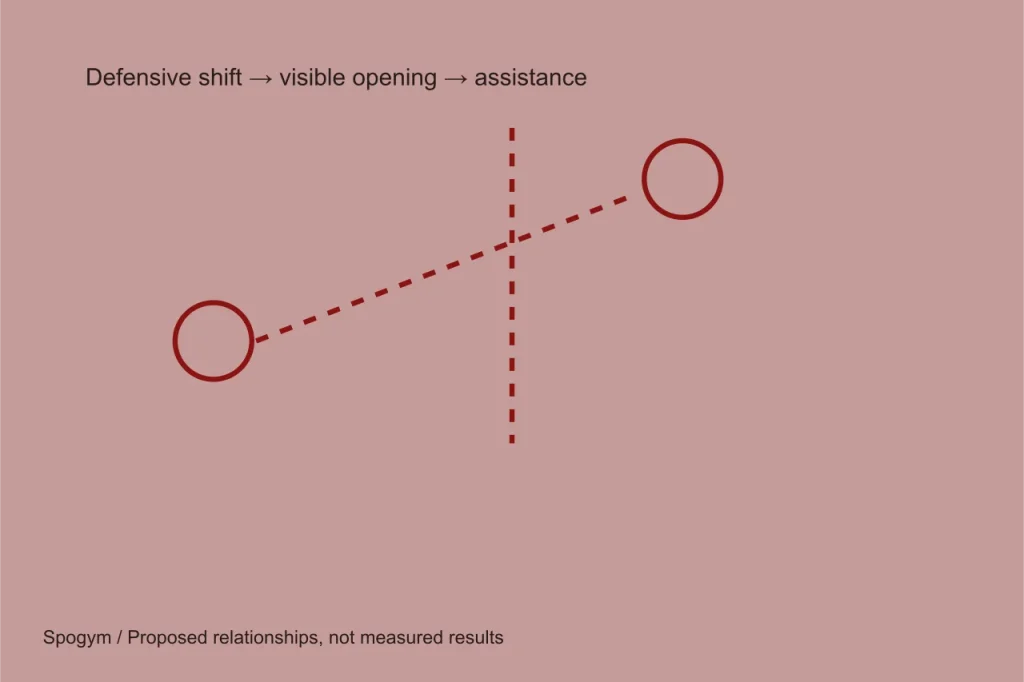
A passing prompt can make a sports game easy to operate while quietly removing the sporting decision. If the correct receiver lights up before the defense communicates anything, the player is following an interface rather than reading the court. For Second Read, we want to examine the opposite order: a visible change in the defense creates a question, and assistance helps explain that question without answering it too early. This is a proposed design approach, not a report of completed player testing.
Begin with an ordinary possession
Imagine the captain receiving the ball on the right side while a teammate starts a rehearsed cut across the lane. The first defender stays close enough to make the direct pass doubtful. A second defender takes a step toward that cut, leaving a different teammate with more space. Nothing supernatural has happened. The useful information is a change in two relationships, and the captain needs enough time and visibility to notice both. An obvious flashing destination would flatten those relationships into a single instruction.
The initial prototype scene should therefore be deliberately modest. We would use a small set of readable positions, familiar movement speeds and one meaningful adjustment. Additional spectators, dramatic camera movement and celebratory effects can wait until the decision itself can be understood. A visually busy possession is not automatically a richer tactical problem.
Separate a cue from an answer
A cue points toward evidence: the defender’s body orientation, a teammate looking back, or a lane that has become briefly available. An answer names the action that should be performed. We want assistance to move gradually between those levels rather than jumping immediately to the final button. The earliest support might clarify which defender changed position. Later help could identify the relationship that change affects. Only an explicit learning mode should need to spell out a suggested response.
This distinction also matters when the player makes a different reasonable choice. A pass can be defensible without being the preferred example. The game should not imply that every possession has one scripted solution simply because the tutorial needs a clear demonstration. We would evaluate whether the outcome follows from the chosen timing and space, not whether the player obeyed a highlighted route.
Preserve the window of uncertainty
The available lane should stay open long enough to be perceived but not indefinitely. Its duration belongs to the movement of the players, not to a timer secretly waiting for a button press. If the captain hesitates, the defense may recover and a reset may become the better action. That changing opportunity is central to the concept described in Second Read.
A missed window should still teach something. The replay could pause at the defender’s first step, then show the space narrowing as the possession continues. It should avoid pretending that the captain possessed information hidden outside the chosen viewpoint. A retrospective explanation must respect what was actually visible at the time.
Review the information order
Our planned review would compare three moments: when the defensive movement begins, when the player can reasonably see it, and when any assistance appears. If assistance consistently leads the evidence, we have built a prompt-following exercise. If evidence is visible only after the opening closes, we have built an unfair guessing task. The useful middle is a readable opportunity with a real cost to hesitation.
The diagram accompanying this note illustrates those relationships without claiming measured reaction times or a finished balance model. Further work would also examine accessibility options that extend explanation without forcing every player to use the same level of help. The companion note on the captain’s viewpoint addresses the camera constraints that make this timing problem more than a matter of interface wording.