
CONCEPT DOSSIER / NOT A RELEASED GAME
Second Read
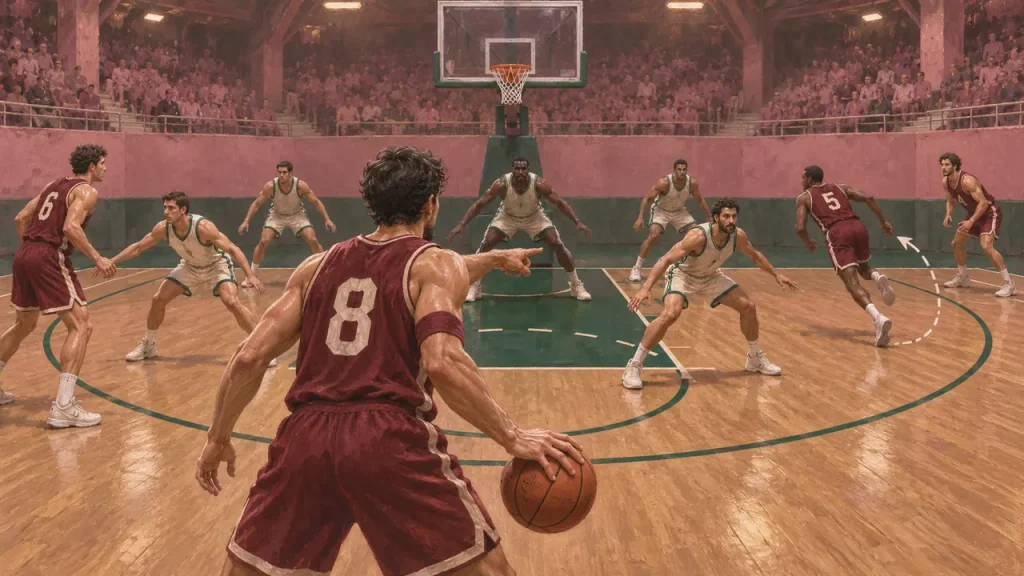
Second Read is a proposed team-sports game centred on the captain’s interpretation of a possession. A rehearsed action establishes an initial passing idea. The defense responds, and the captain must recognise whether that idea still makes sense. The useful next option may come from a teammate moving away from the ball rather than from a spectacular individual move.
Begin with a shared expectation
The opening play gives the team a recognisable starting relationship: a ball handler, a moving teammate and a space the action is intended to create. The captain should understand the purpose without memorising a long diagram. That shared expectation makes a defensive response meaningful. If the first lane closes, the player can identify what changed rather than merely notice that a highlighted target disappeared. A small set of well-explained actions would be more useful initially than a large playbook of opaque patterns.
Read the defender’s commitment
A defender’s orientation and movement can reveal whether they are protecting a lane, following a cutter or preparing to help elsewhere. Those cues must be visible from the captain’s position and consistent enough to support a prediction. The defense-reading note considers how to avoid replacing this task with an interface that supplies the answer. The concept should reward attention while still offering clear teaching support for players unfamiliar with the tactical vocabulary.
Let off-ball movement create the second option
The next useful pass may emerge because a teammate changes the spacing on the weak side. The captain needs to notice the movement, judge the remaining lane and act while the relationship is still available. The off-ball study examines how that movement can feel purposeful without becoming an automatic solution. Teammates should respond to a shared situation, not teleport into a convenient receiving pose whenever the player needs another target.
Keep the perspective on the court
The proposed camera remains connected to the captain rather than switching constantly to an omniscient tactical view. Peripheral cues and readable spacing should help communicate the team without pretending the player can see through every body. Camera options and instructional overlays could support learning, but the core scene must still contain the evidence. The goal is informed uncertainty, not a deliberately obstructed view that makes passing depend on guessing where a teammate went.
A practice arena with a clear language
The art direction uses burgundy uniforms, cream opposition, tan flooring and dark green court markings inside a restrained rose-toned arena. These choices separate actors and useful lines without relying on licensed teams or recognisable athletes. A first setting would keep the background quiet enough to read body orientation and gaps. Sound could reinforce communication, but essential information needs a visual counterpart for players who cannot or prefer not to rely on audio.
Concept stage and the first question
Second Read has no announced public build, release date or licensed roster. A useful first prototype would contain one rehearsed action, one understandable defensive response and more than one reasonable continuation. It would ask whether players can explain why they changed the plan. We have no results to claim. The wider Playbook contrasts this ongoing adaptation with the limited decision window of Last Possession.